

One of the defining features of Path of Exile is the sheer scale and freedom of its passive skill tree. Unlike many action‑RPGs where your build evolves within narrow lanes, PoE gives you a sprawling network of nodes, clusters and keystones that allow for nearly endless build variation. In this article we’ll explore how the passive tree enables unique builds, why the design matters, and how you can use it to construct something truly individual rather than just “the meta”.
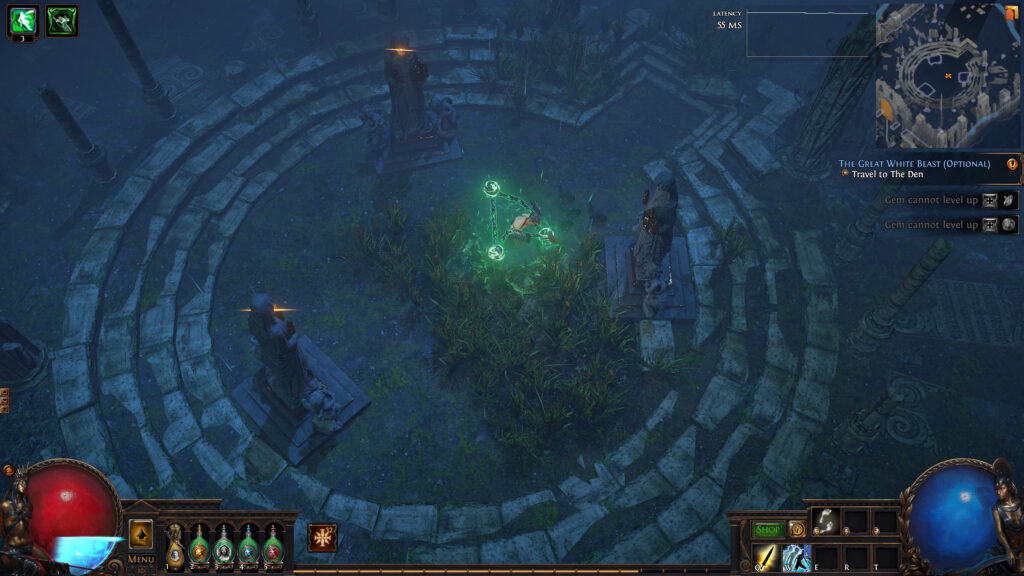
The Architecture of the Passive Skill Tree
The passive skill tree is massive: hundreds of nodes, dozens of clusters, each connected by pathways across a vast web. You begin at one of several start points depending on your class, but from there you may traverse wide into other attributes or specialty areas. This architecture lets you combine attributes like Strength, Dexterity and Intelligence in exotic ways, or specialise deeply into one axis.
Additionally, the tree features keystone passives—major nodes that often change how your build fundamentally works (for example, altering your defence mechanics, damage type or resource usage). Because you must navigate to reach these nodes via the tree’s pathways, your route becomes part of your build’s identity. The passive tree isn’t just a menu—it’s terrain you traverse and build around.
Why It Promotes Build Diversity over “One True Way”
In many ARPGs, once the meta settles you end up with 2‑3 dominant builds and most players follow those. Not so in Path of Exile, largely because the passive tree enables many viable alternative routes. Want to build a caster who uses melee weapons? You can. Want to build a minion‑focused character who also uses high‑speed projectiles? You can. The passive tree opens doors for creativity.
This diversity stems from three core features: the number of nodes, the variety of modifiers (attack, spell, minion, defence, movement), and the fact that you’re rarely locked out of unusual combinations (though they may cost more currency or require more planning). Because of that, two players with similar skills might still end up with very different passive trees and gear paths—and that uniqueness becomes part of the fun.
How to Leverage the Tree to Create Something Unique
Here’s how you can approach the tree if you want to build something unlike everyone else:
- Start with your core mechanic:
- Identify key keystone nodes or clusters:
- Traverse creatively:
By doing so, your build becomes more than “copy‑the‑template” and instead becomes your expression. The passive tree rewards planning, experimentation and deviation from the norm—in other words, uniqueness.
The Trade‑Offs of Uniqueness and Why They Matter
Of course, choosing a unique path often comes with trade‑offs. Some nodes may be further away, meaning you spend more skill points on travel. Some unusual build choices may require off‑meta gear or higher currency investment. But these trade‑offs are what make the build feel distinct—and often more rewarding when they succeed.

Embracing an unconventional route means you’re often solving problems others ignore: how to scale defence in a fragile spell build, how to generate charges when you picked no standard charge nodes, how to maximise movement or utility rather than raw damage. The passive tree gives you the tools to solve those problems—but you must accept the cost. That cost is what turns a fun build into a memorable one.
Why It’s Rare Among Action RPGs
Many ARPGs offer a linear progression or a few branching trees, but Path of Exile delivers a sprawling “web” that applies to all classes and all builds. This kind of flexibility is rare because it increases complexity for both player and designer—but PoE embraces it. Because of this, players often say that even after hundreds of hours they still discover new ways to build.
Moreover, the tree’s integration with gear, skill gems, support gems, ascendancy, and crafting all means that your build isn’t just “which skill I pick” but “how I route the tree, how I gear for it, how I link my supports, how I optimise movement and utility”. It becomes a system of many interlocking parts—and the passive tree is the spine of that system.
Conclusion: Use the Tree to Make the Build Yours
If you want to build something unique in Path of Exile, focus on the passive skill tree early: pick your key nodes, map your route, embrace the detours. The fun of PoE isn’t just beating the endgame—it’s arriving there via a path that *you* chose. The passive skill tree gives you that path. Whether you aim for a meta‑shredding speed build or a quirky niche build that only you and a few others play, the tree supports it. Use it as your canvas and build something which reflects your playstyle rather than someone else’s.





Leave a Reply